Are You Ignoring This Threat to Your Bees? 11 Varroa Facts Every Beekeeper Needs to Know
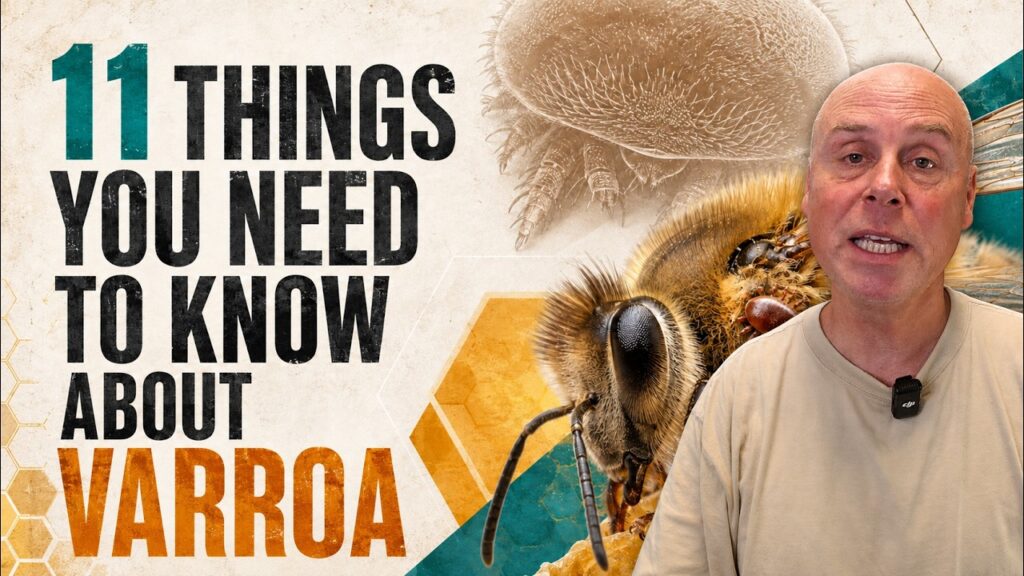
Varroa mites are in virtually every honey bee colony—or eventually will be. The question isn’t whether your bees have mites. The question is whether you have a plan to manage them.
In this video, Certified Master Beekeeper Ray Hewitt answers 11 important questions every beekeeper should understand about Varroa destructor. We’ll look at how Varroa damages bees, spreads viruses such as Deformed Wing Virus, reproduces inside capped brood, and can cause colonies to collapse months after the damage begins.
YOU’LL LEARN:
• Why you cannot judge a colony’s mite level by sight
• Why hope is not a Varroa-management strategy
• What testing tells you before and after treatment
• How to collect a useful 300-bee sample
• Why the location and age of sampled bees matter
• The strengths and limitations of alcohol washes, soap washes, and sugar shakes
• What can happen when colonies are left untreated
• Why summer mite levels affect the health of winter bees
• How temperature, brood, honey supers, treatment duration, and resistance affect treatment selection
• Important considerations for Apivar, Apiguard, oxalic acid vaporization, VarroxSan, and Norroa
• Why there is no single “best” treatment—only a well-designed Varroa-management plan
Successful Varroa control requires an integrated approach: monitor regularly, select treatments that fit the colony and conditions, rotate active ingredients when appropriate, and confirm that each treatment worked.
Always read and follow the current product label. Incorrect dosage, placement, timing, temperature, colony size, or honey-super status can reduce effectiveness or harm the colony.
YOUR NEXT STEP: Do a mite wash this week. Test, treat when necessary, and test again.
🐝 SHOP HONEY TOP BEES PRODUCTS
https://www.honeytopbees.com/shop/
🎓 TAKE RAY’S ULTIMATE BEGINNER BEEKEEPING VIDEO COURSE
https://www.honeytopbees.com/shop/video-beekeeping-courses/
🌐 LEARN MORE ABOUT HONEY TOP BEES
https://www.honeytopbees.com/
▶️ SUBSCRIBE FOR PRACTICAL, RESEARCH-BASED BEEKEEPING EDUCATION
https://www.youtube.com/@HoneyTopBees
#VarroaMites #Beekeeping #HoneyBees #VarroaManagement #beekeeper
SOURCES AND FURTHER READING
Kraus, B., Koeniger, N., & Fuchs, S. (1986). Recognition and preference of bees of specific age by Varroa jacobsoni. Apidologie, 17(3), 257–266.
https://doi.org/10.1051/apido:19860307
Schneider, P. (1985). Befall von Sammlerinnen, Stockbienen, Flugdrohnen und Stockdrohnen mit Varroa jacobsoni. Apidologie, 16, 209–211.
Lee, K. V., Moon, R. D., Burkness, E. C., Hutchison, W. D., & Spivak, M. (2010). Practical sampling plans for Varroa destructor in Apis mellifera colonies and apiaries. Journal of Economic Entomology, 103(4), 1039–1050.
https://doi.org/10.1603/EC10037
Oliver, R. (2020). Re-Evaluating Varroa Monitoring, Part 2: Questions on Sampling Hives for Varroa. Scientific Beekeeping.
https://scientificbeekeeping.com/re-evaluating-varroa-monitoring-part-2/
Oliver, R. (2020). Re-Evaluating Varroa Monitoring, Part 3: How Does Mite Distribution Vary Frame-to-Frame in a Hive? Scientific Beekeeping.
https://scientificbeekeeping.com/re-evaluating-varroa-monitoring-part-3/
Taylor, M. A., Goodwin, R. M., McBrydie, H. M., Cox, H. M., & Dominiak, B. C. (2025). Relative effectiveness of methods that sample worker honey bees to estimate Varroa destructor populations in Apis mellifera colonies. Apidologie, 56, Article 14.
https://doi.org/10.1007/s13592-024-01143-y
Oliver, R. (2020). Refining the Mite Wash, Part 1: Treatment Threshold and Solutions to Use. Scientific Beekeeping.
https://scientificbeekeeping.com/refining-the-mite-wash-part-1-treatment-threshold-and-solutions-to-use/
Oliver, R. (2020). Refining the Mite Wash, Part 3: Dislodgement, Precipitation and Separation. Scientific Beekeeping.
https://scientificbeekeeping.com/7028-2/