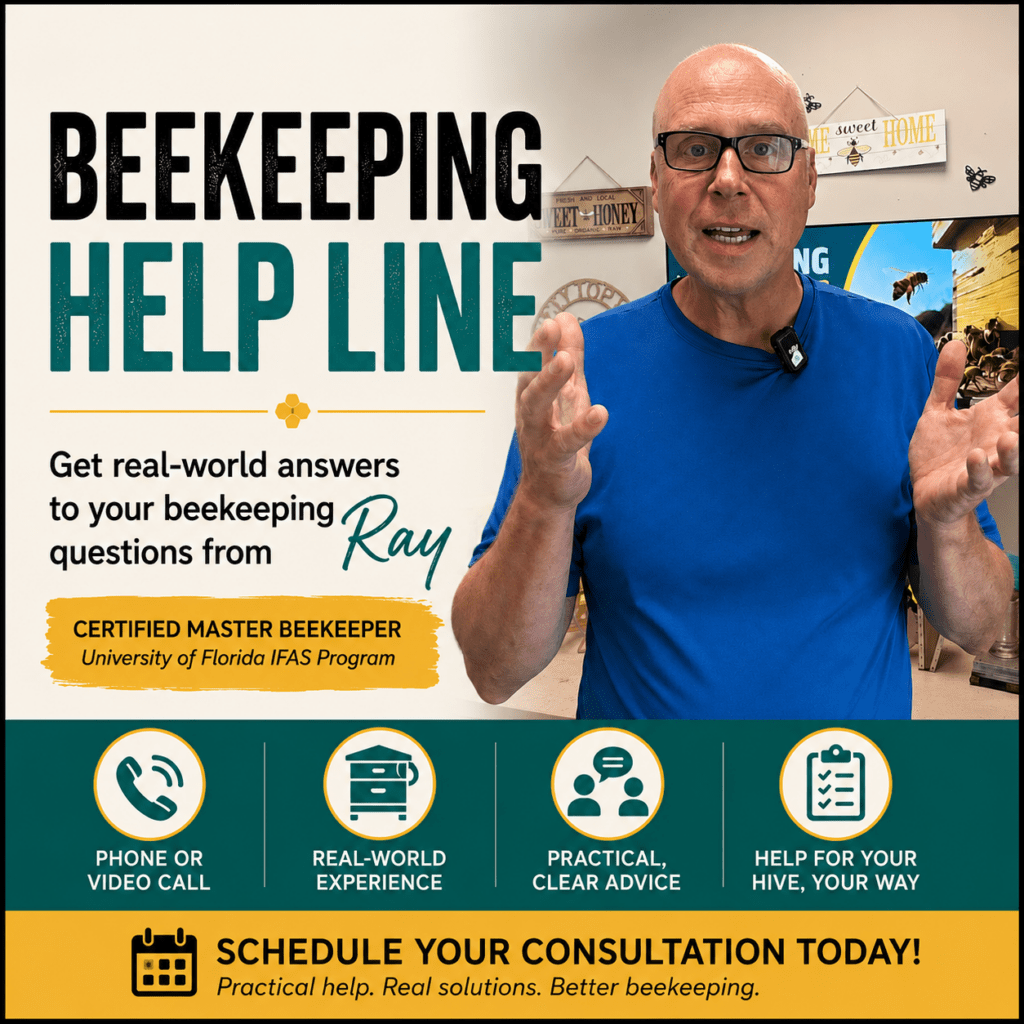
Need help figuring out what is happening in your hive? Have a hive problem, management question, or situation you’re not sure how to handle?
Schedule a phone or video consultation with Ray from Honey Top Bees, a Certified Master Beekeeper, and get practical help based on what is actually happening in your colony.
This service is designed for beekeepers who need clear, real-world guidance without waiting for the next club meeting or trying to sort through conflicting advice online.
Whether you are dealing with queen issues, weak colonies, swarm concerns, feeding questions, mite treatment timing, hive inspections, or seasonal management decisions, we can talk through what you are seeing and help you decide your next step.
Choose the consultation option that best fits your question.
Checkout. After checkout, Ray will contact you by email to schedule a time for your phone or video call.
Before the call, send your main question by email or text, with your name, along with any helpful photos or video. This allows us to make better use of your time and focus on the real issue. During the consultation, we will focus on one main hive or issue at a time so the advice stays clear and practical.
Most sessions are handled personally by Ray Hewitt of Honey Top Bees, a certified Master Beekeeper through the University of Florida IFAS program. Occasionally, if Ray’s schedule is full, one of his trained students or trusted Master Beekeeper friends may assist. Either way, the goal is the same: practical, reliable guidance for your specific beekeeping situation.
Choose the option that best fits your question or situation.
To get the best help during your consultation, it is helpful to send your main question or concern before we meet.
If possible, include clear photos or a short video of the hive, brood frames, queen cells, bees, entrance activity, or anything else related to the issue. This gives us a better starting point and helps us use your time wisely.
During the session, we will focus on one hive or one main issue at a time. This keeps the conversation clear and allows for better, more practical recommendations.
A few helpful things to know before we meet:
When was the hive last inspected?
Is the colony queenright?
What did the brood pattern look like?
How many frames of bees are in the hive?
Are there eggs, larvae, capped brood, honey, and pollen?
Have you tested for mites recently?
Have you treated for mites, and if so, when and with what?
What is your main goal: saving the hive, finding the queen, requeening, splitting, feeding, treating mites, or preparing for the next season?The
The more specific information you can provide, the more useful the consultation will be.
Beekeeping can be confusing, especially when you are trying to decide what to do next. A consultation can help you think through your situation and make a practical plan.
Common topics include:
Queen problems or suspected queenlessness
Requeening decisions
Weak colonies
Swarm prevention or swarm recovery
Splits and nuc management
Feeding questions
Mite testing and treatment timing
Brood pattern concerns
Hive inspection questions
Seasonal management decisions
Comb problems
Overwintering preparation
General second opinions
Every hive situation is different, so the goal is not to give generic advice. The goal is to help you understand what you are seeing and decide on the best next step for your colony.
A phone or video consultation can be very helpful, but some hive problems cannot be diagnosed with certainty from a distance.
We can review your photos, videos, inspection notes, and description of what you are seeing, then help you think through the most likely causes and next steps.
However, we cannot guarantee an exact diagnosis without being physically present in the hive. Some issues, including certain diseases, queen status concerns, pesticide exposure, starvation, mite-related problems, or brood abnormalities, may require an in-person inspection, lab testing, or help from your local bee inspector.
Our goal is to give you practical guidance, help you avoid common mistakes, and point you toward the best next step based on the information available.
Side Note: It is recommended that you take the video course first. It is designed to be a reference tool for you with lifetime access. It will answer many of your questions
Would you like to receive Ray’s free Beekeeper’s Tips and Updates?